
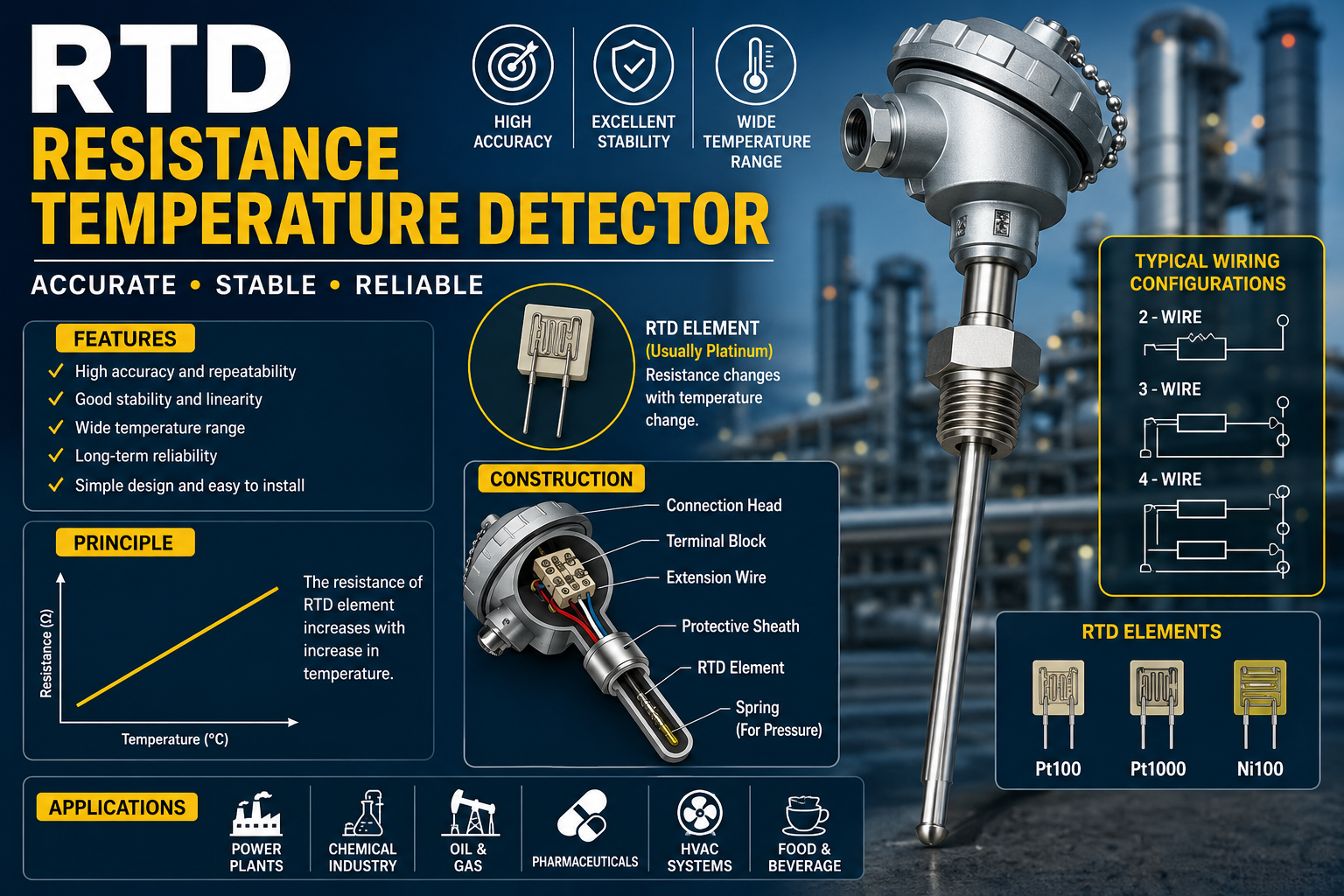
RTD Kya hoti he Kaha kaha use hoti he RTD Ke kitni prakar ki hoti he or Multimeter se kese check karte he.
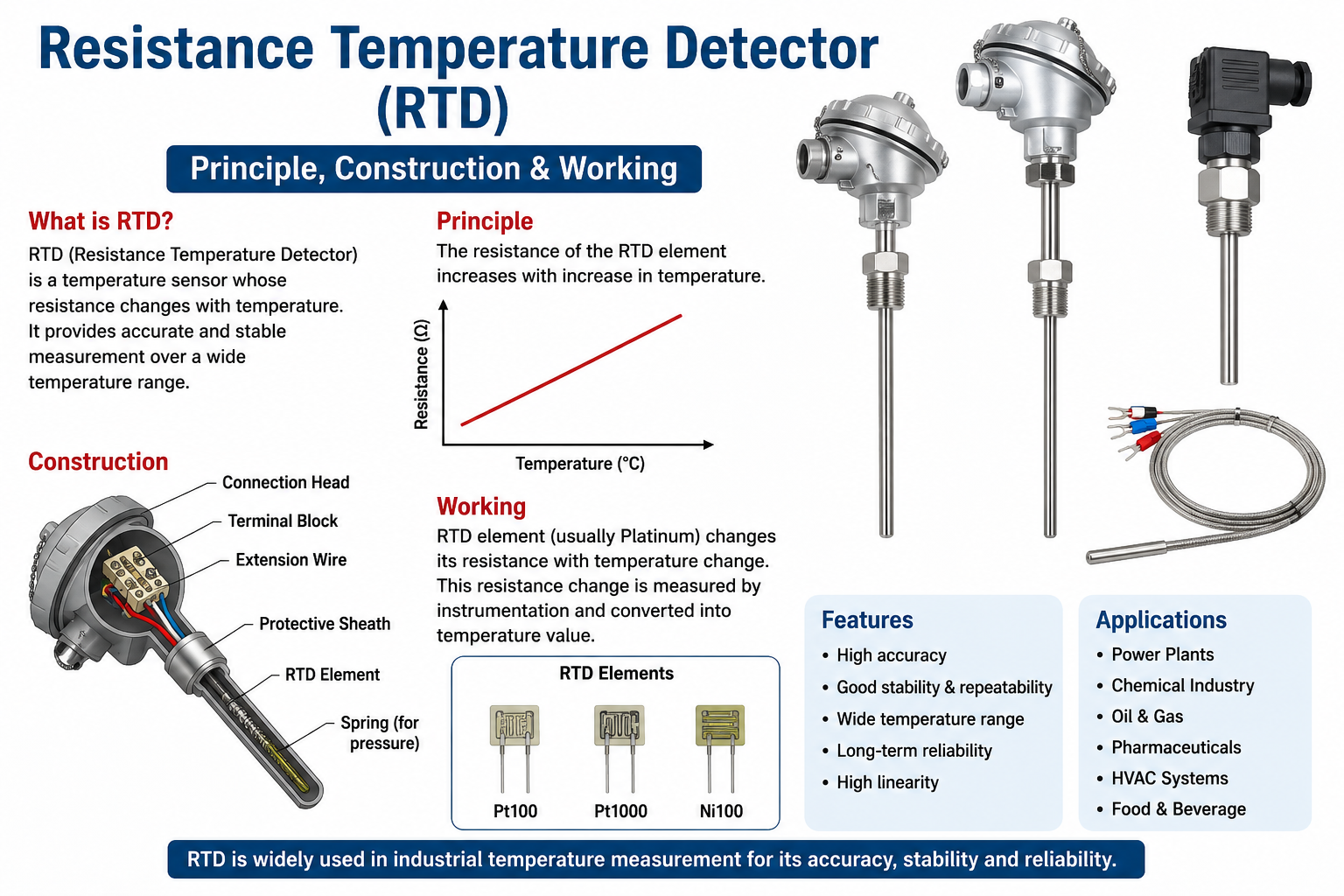
Aaj ke industrial aur scientific world me temperature measurement bahut important hota hai. Isi ka ek reliable device hai Resistance Temperature Detector (RTD). RTD ek aisa sensor hota hai jo temperature ko measure karne ke liye metal ki resistance change hone ka use karta hai. https://mentorversehub.com/resistance-%e0%a4%b0%e0%a5%87%e0%a4%9c%e0%a4%bc%e0%a4%bf%e0%a4%b8%e0%a5%8d%e0%a4%9f%e0%a5%87%e0%a4%82%e0%a4%b8-in-hindi/
Resistance Temperature Detector :
RTD ek temperature sensor hai jo is principle par kaam karta hai ki jaise-jaise temperature badhta hai, metal ki electrical resistance bhi badhti hai.
Sabse commonly use hone wala RTD material hai Platinum, kyunki ye accurate aur stable readings deta hai.
Working Principle :
RTD ka kaam temperature vs resistance relationship par based hota hai.
- Jab temperature increase hota hai → resistance increase hoti hai
- Jab temperature decrease hota hai → resistance decrease hoti hai
Is relation ko mathematically bhi express kiya ja sakta hai, jisse exact temperature calculate kiya jata hai.
Types of Resistance Temperature Detector:
RTD mainly 3 types ke hote hain:
- 2-wire RTD – Simple hota hai, lekin accuracy kam hoti hai
- 3-wire RTD – Industrial use me common hai, better accuracy
- 4-wire RTD – Sabse accurate hota hai, scientific applications me use hota hai
Advantages of RTD :
- High accuracy
- Stable output
- Wide temperature range (-200°C se 600°C )
- Long-term reliability
Disadvantages of RTD :
- Cost zyada hota hai (especially platinum RTD)
- Response time thoda slow hota hai
- Shock aur vibration se damage ho sakta hai
Applications of RTD –
RTD ka use kai industries me hota hai:
- Power plants
- Chemical industries
- Food processing
- HVAC systems
- Laboratories
RTD (Resistance Temperature Detector) ko multimeter se check karna kaafi simple hai. Tumhe bas resistance (Ω) measure karna hota hai.
Step-by-step process:
1. Multimeter ko set karo –
Multimeter ko Resistance (Ω mode) par set karo
Agar auto-range hai to direct use karo, warna 200Ω ya 2kΩ range select karo
2. RTD ke wires identify karo –
RTD 3 type ke hote hain:
2-wire RTD
3-wire RTD
4-wire RTD
Sabse common hai PT100 RTD
3. Resistance measure karo –
Probes ko RTD ke terminals par lagao
Reading observe karo
Expected values (PT100 ke liye):
0°C → ~100Ω
25°C → ~109Ω
100°C → ~138.5Ω
Agar room temperature par ho to approx 107–110Ω ke aas paas aana chahiye
Check karne ke tarike:
Normal condition:
Stable resistance value mile
Temperature badhane par resistance increase ho (RTD me positive coefficient hota hai)
Faulty RTD:
OL / infinite → wire broken
0Ω ya bahut low → short circuit
Value unstable → connection loose ya sensor damage
Practical test:
RTD ko haath se pakdo ya thoda garam karo
Resistance badhna chahiye
Thanda karo
Resistance kam hona chahiye
Important tips:
Power supply connected na ho (RTD ko direct multimeter se check karo)
Long cable me thoda resistance extra aa sakta hai
3-wire/4-wire me same color wires ka resistance check karke compare karo
RTD (Resistance Temperature Detector) ka use mainly accurate temperature measurement ke liye hota hai. Ye sensors industry me bahut reliable maane jaate hain.
RTD kaha-kaha use hoti hai:
1. Industrial plants –
Chemical factories
Oil & gas plants
Power plants
Machines, pipelines aur tanks ka temperature measure karne ke liye
2. Power generation –
Boilers
Turbines
Generators
Overheating detect karne ke liye RTD lagayi jaati hai
3. Manufacturing industry –
Plastic molding machines
CNC machines
Furnaces
Process temperature control ke liye
4. HVAC systems –
AC plants
Chillers
Cold storage
Room ya system ka temperature maintain karne ke liye
5. Medical field –
Laboratory equipment
Incubators
Precise temperature control zaroori hota hai
6. Automotive industry –
Engine temperature monitoring
Performance aur safety ke liye
7. Food industry –
Ovens
Refrigeration units
Food safety ke liye temperature control
8. Research & labs –
Experiments me accurate temperature measurement ke liye
◊ RTD kyu use hoti hai?
High accuracy , Stable readings, Long life, Wide temperature range.
Common type:
PT100 RTD (sabse zyada use hota hai)
RTD (Resistance Temperature Detector) use karne ke apne clear fayde (advantages) aur nuksan (disadvantages) hote hain. Main simple language me samjha deta hoon:
Resistance Temperature Detector ke fayde:
1. High accuracy –
RTD bahut accurate hoti hai, isliye jahan exact temperature chahiye wahan use hoti hai
jaise labs, industries
2. Stable output –
Time ke saath reading zyada change nahi hoti (drift kam hota hai)
3. Linear response –
Temperature badhe to resistance almost straight line me badhta hai
Calculation aur control easy ho jata hai
4. Wide temperature range –
Approx: -200°C se 600°C tak measure kar sakti hai
common type: PT100 RTD
5. Long life –
Proper use me RTD bahut saal tak chalti hai
RTD ke nuksan:
1. Mehngi hoti hai –
Thermocouple se compare kare to RTD costly hoti hai
2. Response slow hota hai –
Temperature change ko detect karne me thoda time lagta hai
fast processes me problem ho sakti hai
3. Fragile – RTD ka element delicate hota hai
vibration ya shock se damage ho sakta hai
4. Wiring complex hoti hai
3-wire / 4-wire connection thoda complicated hota hai
Installation me dikkat aa sakti hai
5. Limited high temperature
Bahut high temperature (>600°C) ke liye suitable nahi hoti
wahan thermocouple better hota hai
Short comparison:
Accuracy chahiye → RTD best
Fast response ya high temp chahiye → Thermocouple best
RTD vs Thermocouple :
-
Feature RTD Thermocouple Accuracy High Medium Range Limited Very high Cost High Low Stability Excellent Moderate
https://www.slideshare.net/slideshow/rtdresistance-temperature-detector/238543993